Posted in the Submissions section · Created 2026-05-21 · Updated 2026-05-27 · FMZ Quant
1. The Biggest IPO Wave in History — Are Retail Investors Just Left Watching?
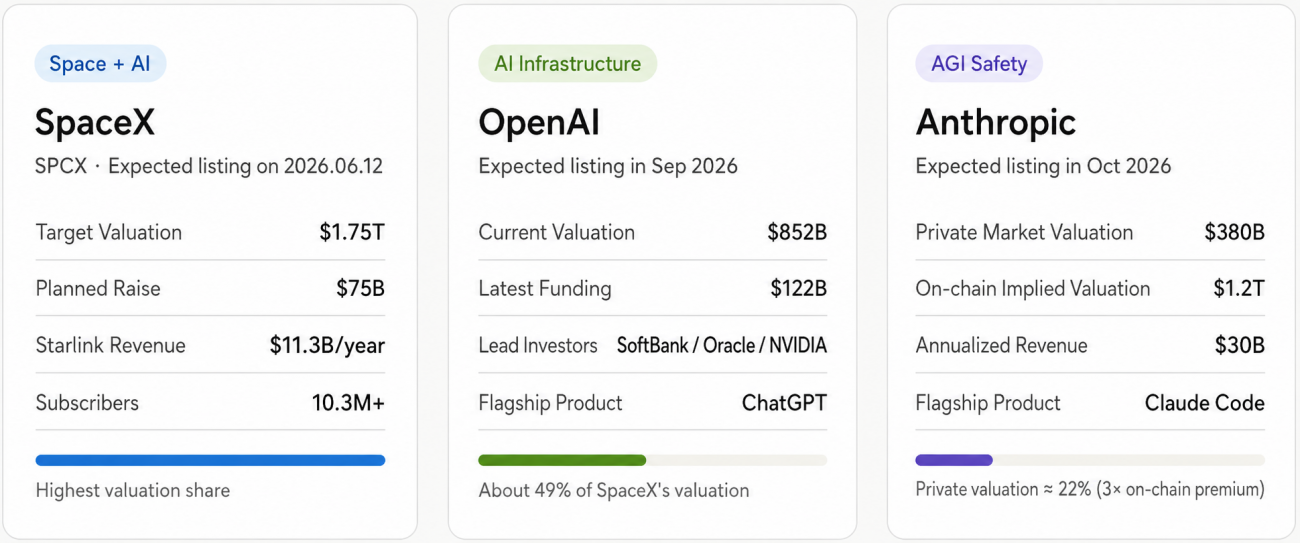
In 2026, the tech capital markets are riding an unprecedented wave of AI giants going public. Three companies, three narratives, with a combined valuation approaching $4 trillion.
SpaceX:
On April 2, 2026, SpaceX confidentially filed its IPO application with the SEC, targeting a $1.75 trillion valuation and aiming to raise up to $75 billion — potentially the largest IPO in human history, surpassing Saudi Aramco’s prior record. The roadshow is set to begin June 5, ticker symbol SPCX, with trading expected to start June 12. Having merged with Musk’s AI company xAI, SpaceX is now a “space + AI” dual-engine super-giant. Starlink’s full-year 2025 revenue topped $11.3 billion, growing nearly 50% year-over-year, with over 10.3 million subscribers.
OpenAI:
Just today (May 21, 2026), it was confirmed that OpenAI will file its draft IPO prospectus within the week at the earliest, targeting a September 2026 listing. Its current valuation has reached $852 billion, and this funding round of $122 billion sets a new global record for a single startup funding round, co-led by SoftBank, Amazon, and NVIDIA. ChatGPT became the fastest product ever to break 100 million users, and AI infrastructure is becoming the “water and electricity” of a new era.
Anthropic:
The most underrated of the bunch. In February 2026, Anthropic closed its Series G, raising $30 billion at a $380 billion valuation, led by Singapore’s sovereign fund GIC and Coatue. Yet in the on-chain Pre-IPO market, investors’ implied valuation has soared to $1.2 trillion — a 3x premium over the primary market. Driving this frenzy is the explosive spread of Claude Code among developers: Anthropic’s annualized revenue jumped from $9 billion at the end of 2025 to $30 billion by May 2026 — tripling in three months. The market currently expects its IPO to land as early as October 2026.
Three companies — one is the gateway to AI compute, one is humanity’s interstellar exit, and one is the research institution closest to the AGI safety frontier. Standing in 2026, “AI is the primary productive force” is already global consensus, and these three targets represent almost the entirety of “the future” itself.
But here’s the problem:
- Opening a U.S. brokerage account is a tedious process — passport, bank statements, overseas accounts…
- The vast majority of IPO subscription allocations are locked up by institutions and VIP investors
- Even if you can buy in, SpaceX is priced from $420 per share (at current secondary-market prices)
- Most importantly — you simply can’t grab any first-day shares
So is there any way for retail investors to participate?
2. Crypto Got There First: Pre-IPO Contracts Are Already Live
The answer is: of course there is.
Crypto markets have always had a keen nose. Within a week of SpaceX filing its IPO application, the four major exchanges — Binance, OKX, Bitget, and BingX — successively launched SpaceX Pre-IPO product lines, putting targets that used to be reachable only by institutions and VIPs directly in front of every ordinary user.
There are currently three main ways to participate:
| Product Type | Platform | Description |
|---|---|---|
| Pre-IPO Perpetual Contract | OKX | USDT margin, up to 5x leverage, 24/7 trading |
| On-chain RWA Spot Token | Binance / OKX / BingX | Issued via the PreStocks protocol; 1:1 backed by underlying private shares held in an SPV; circulates on the Solana chain |
| Synthetic Subscription Token | Bitget | Issued by Republic; price tracks SpaceX’s future public-market performance; settled in stablecoin after IPO |
Important note: None of the above products are real equity — they carry no voting rights, no dividend rights, and no shareholder status. OKX’s perpetual contract, for example, is priced at “one-billionth of SpaceX’s total valuation,” provisionally assuming 1 billion shares as the estimated total share count; once the S-1 officially discloses the actual share count, a Rebase (share adjustment) will be executed.
SpaceX is far from the only case. Behind this wave of Pre-IPO mania is a microcosm of the crypto market’s broader RWA (Real-World Asset tokenization) explosion. Tech unicorn targets already live or in the pipeline include:
| Target | Expected IPO | Current Valuation | On-chain / Contract Status |
|---|---|---|---|
| SpaceX | June 2026 | $1.75T | OKX perpetuals & Binance RWA tokens both live |
| OpenAI | Sept 2026 | $852B | On-chain Pre-IPO tokens already trading |
| Anthropic | Oct 2026 | $380B ($1.2T implied on-chain) | Pre-IPO tokens live on Jupiter and other platforms |
| Cerebras | Already public | — | Contracts live on Trade.xyz; volume hit nearly $100M in the hour before IPO |
The on-chain perpetuals market is expanding rapidly — Hyperliquid’s RWA open interest has broken through a record $2.5 billion high. This sector’s boom is only just beginning.
3. The Logic of “Sipping the Broth”: Enter the Grid Strategy
Of course, going all-in on a single Pre-IPO product is no different from buying a lottery ticket — violent volatility, limited liquidity, and news that’s half-true, half-false.
Capturing the full rally is hard for retail investors. But using a quant strategy to continuously harvest the spread amid the chop is a different matter entirely.
That brings us to today’s protagonist: the grid strategy.
Some say the grid strategy is too old. True — it isn’t new. But in crypto markets, “old” is precisely a compliment. Having survived countless bull-bear cycles and extreme conditions, it remains one of the most battle-tested quant strategies and one of the best suited to high-volatility instruments. A tool isn’t worse for being old — what matters is that it works.
3.1 What Is a Grid Strategy?
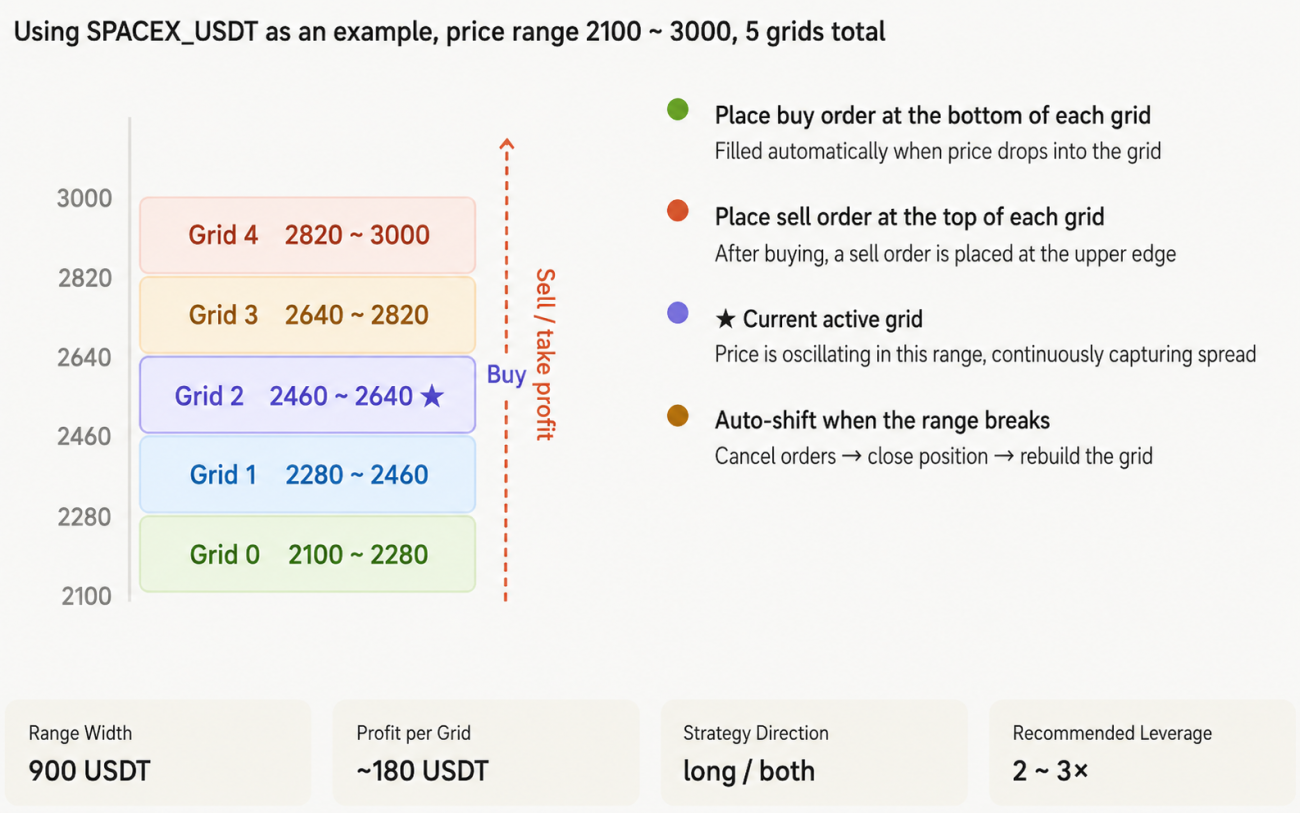
The core idea of a grid strategy is extremely simple: slice a price range into a number of cells, buy at the bottom of each cell and sell at the top, repeating the cycle to earn the spread.
Take SPACEX_USDT as an example. Suppose we judge the price will oscillate between 2100 and 3000:
Upper bound: 3000
├── Cell 4: 2820 ~ 3000 ← buy@2820, sell@3000
├── Cell 3: 2640 ~ 2820 ← buy@2640, sell@2820
├── Cell 2: 2460 ~ 2640 ← buy@2460, sell@2640
├── Cell 1: 2280 ~ 2460 ← buy@2280, sell@2460
└── Cell 0: 2100 ~ 2280 ← buy@2100, sell@2280
Lower bound: 2100
Each time the price rises from the bottom of a cell to its top, it completes one “buy low, sell high,” locking in one cell’s profit. The more frequently the price oscillates, the more times you profit.
3.2 This Strategy’s Core Upgrade: Dynamic Moving Grid
A static grid has a fatal flaw: once price breaks out of the range, the strategy is dead.
This article uses the V4 dynamic moving version, which solves that pain point:
① Percentage parameters, adaptable to any price magnitude
# Range width, shift amount, and trigger offset all use percentages
# GRID_WIDTH_PCT = 30 → range width = current price × 30%
# SHIFT_STEP_PCT → each shift = current price × x%
# BREAKOUT_TRIGGER_PCT → trigger offset = reference price × x%

def pct_to_abs(pct, ref_price):
    return ref_price * pct / 100.0
This means whether SPACEX is 500 or 5000, the parameters don’t need to change.
② Automatically moves the range after a breakout
def check_breakout_and_shift():
    price = get_price()
    ref_price = (range_low + range_high) / 2.0
    trigger_offset = pct_to_abs(BREAKOUT_TRIGGER_PCT, ref_price)

    # Upper-bound breakout → shift range up
    if price >= range_high + trigger_offset:
        return _do_shift_up(price)

    # Lower-bound breakout → shift range down
    if price <= range_low - trigger_offset:
        return _do_shift_down_auto(price)
When price breaks through the upper bound (e.g., SpaceX surges), the strategy automatically:
- Cancels all open orders
- Market-closes all positions
- Computes a new range
- Re-deploys the grid
It doesn’t miss trending moves, nor does it stubbornly hold onto losses.
③ Three directional modes for flexibility
direction = "long"  → only place buy orders below price (go long)
direction = "short" → only place sell orders above price (go short)
direction = "both"  → split at the range midline: lower half long, upper half short
Too many cells: each cell’s profit can’t cover the fees — wasted effort. Too few cells: capital sits idle. Dynamic calculation makes the cell count just right.
3.3 Strategy Parameter Configuration Reference
The strategy has the following core parameters, all configurable directly in the parameter panel on the FMZ platform:
| Parameter | Type | Recommended | Meaning |
|---|---|---|---|
| SYMBOL | string | SPACEX_USDT | Trading pair; the strategy auto-appends the .swap suffix to form the contract code |
| INIT_PRICE | number | Near current price | Initial range anchor. In long/both modes it’s the upper bound; in short mode the lower bound. Set to 0 to auto-anchor at the current price |
| DIRECTION | string | long | Direction mode: long / short / both. Before the SpaceX IPO, long or both is recommended |
| GRID_WIDTH_PCT | number (%) | 20~40 | Total grid range width as a % of price. 30 means range width = current price × 30%. Wider → fewer cells, higher profit per cell, but lower trigger frequency |
| SHIFT_STEP_PCT | number (%) | 5~10 | Step size (%) for each range shift. Smaller → more sensitive, tracks price tighter; larger → more inertia, slower to move |
| BREAKOUT_TRIGGER_PCT | number (%) | 0~2 | How far price must exceed the boundary to trigger a shift. 0 = triggers the moment price touches the boundary; 2 = requires exceeding by 2%, reducing frequent shifts |
| LEVERAGE | number | 2~5 | Contract leverage. Pre-IPO contracts are extremely volatile — keep it under 5x; 2~3x for conservative participation |
| FEE_RATE | number | 0.0005 | One-way fee rate (0.05%), used to compute each cell’s minimum profit space so the cell spacing covers round-trip fees |
| FEE_PROFIT_MULTI | number | 1.5~2 | Fee-coverage multiple. 2 means each cell’s profit must be at least 2x the fee, avoiding pointless effort |
| EMPTY_TIMEOUT_BARS | number | 0 | Empty-position timeout protection. Triggers an alert after N consecutive bars with no position; 0 disables this |
| POLL_INTERVAL | number (ms) | 3000~5000 | Main loop polling interval (ms). Smaller → faster response; larger → friendlier to API rate limits |
4. Why Are Pre-IPO Contracts Well Suited to Grids?
Grid strategies love three kinds of market environments: high volatility, wide-range oscillation, and a trend that isn’t a one-directional ramp.
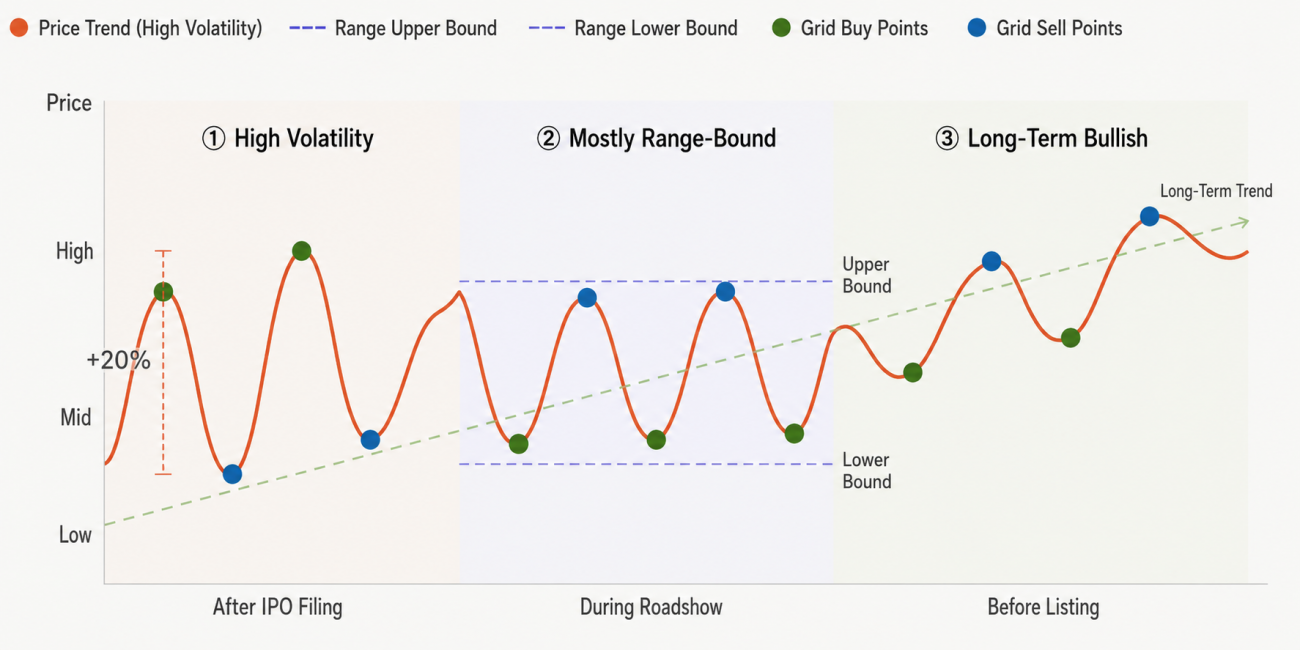
SpaceX Pre-IPO contracts happen to satisfy all three:
- High volatility: Contract pricing is driven entirely by market sentiment and valuation expectations, with strong news-driven moves — a single roadshow headline can swing the price ±20%
- Oscillation-dominated: Plenty of uncertainty exists before the IPO (pricing, window, market conditions), so price won’t ramp in one direction
- Bullish long-term: The big AI + space narrative isn’t going away — every pullback is a chance for the grid to add positions
5. Things to Note (Must Read)
⚠️ Everything described here is a quant-strategy discussion and does not constitute any investment advice.
Before actually operating, be sure to understand the following risks:
- The product is essentially a synthetic derivative. What you hold is not real SpaceX stock and carries no shareholder rights. The price may trade at a significant premium or discount to the real share price.
- IPO failure risk. If the SpaceX IPO is ultimately delayed or canceled, the platform reserves the right to settle at a self-determined price or delist the product, at which point liquidity could shrink sharply.
- Limitations of the grid strategy.
- One-directional surge: the range shifts up frequently, and each move requires closing and rebuilding, losing held-position profit
- One-directional crash: after shifting the range down, positions can sink ever deeper — strictly control total position size
- Recommendation: keep the grid strategy’s total position under 30% of total assets, leaving ample buffer
- Contract leverage risk. Pre-IPO contracts are extremely volatile on their own — keep leverage at 2~3x. Better to earn less than to get liquidated.
- Parameters need tuning against live trading. Backtest environments differ from live trading in slippage, depth, etc. Start GRID_WIDTH_PCT with a wide 30% range to run stably, then narrow it gradually.
- Binance algorithmic trading requires manually enabling authorization. Before using algorithmic trading (API auto-ordering) on Binance, you must find the “algorithmic trading” option in account settings and manually click to agree to the corresponding service agreement or authorization option — otherwise API order requests will be rejected. Confirm this step is complete before connecting the strategy.
6. Summary
The listings of SpaceX and OpenAI symbolize that the value of the AI era’s most core assets is now officially being priced by public markets. While retail investors find it hard to grab the most-prioritized shares during the IPO window, the crypto market’s Pre-IPO contracts already offer an entry point.
Within that entry point, the goal isn’t to guess up or down, but to use the grid strategy to continuously harvest the spread amid the chop — and that’s the posture a quant practitioner should have.
The big trend is irreversible; “AI is the primary productive force” is consensus. But before the trend becomes clear, oscillation is the norm. The grid — this plain, unassuming old strategy — will always have its place in the high-volatility crypto market.
Disclaimer: This article is for strategy research and technical sharing only and does not constitute investment advice. Crypto derivatives trading is extremely high-risk; make independent judgments based on your own situation only after fully understanding the risks.
Strategy source code: Universal Grid Strategy (Dynamic Moving Version)